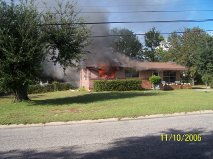
Escambia VES GRAB

🚒 A rapid response from Escambia County firefighter Charles Bailey saved the life of a victim trapped inside a home on Sunday, July 19.

👨🏽‍🚒 Bailey, rescued one adult from the window of a home after just 1 minute and 40 seconds.

“This is an outstanding display of situational awareness, confidence, training, and actions leading to the saving of a life,” said Paul Williams, Escambia County Interim Fire Chief. “This was one of those times that required immediate action, and firefighter Bailey’s response was the right decision for the situation in which he encountered.”

👉Read the full story here: bit.ly/2D03mki

Searching Without a Line!

SEARCHING WITHOUT A LINE: WHAT WOULD YOU DO?
05/01/1998

More Articles like this at http://www.fireengineering.com

SEARCHING WITHOUT A LINE: WHAT WOULD YOU DO?
BY MIKE LOMBARDO
Risk analysis models influence much of the fireground decision making in the fire service today. But at times we are called to go against these models, act against the odds. The results of such actions are sometimes tragic and sometimes successful. Regardless of the outcome, the fire service must remember that we are a human service, and a standard set of rules or guidelines cannot always dictate the actions of the firefighters who serve the public.
On the evening of January 29, 1998, at approximately 6:30 p.m., a full first-alarm assignment was dispatched to a report of a fire on Townsend Street in Buffalo, New York. The assignment consisted of three engine companies, two truck companies, a rescue company, and a battalion chief.
Truck 11 arrived right behind Battalion 3; the fire was only two blocks from the unit`s quarters. It is a single unit stationed only with the chief; it carries no water and was staffed that evening with five firefighters and an officer. On arrival, the fire was observed venting from two doors and two windows on the number 4 side, from the first-floor rear apartment of this two-story wood-frame dwelling.
With very heavy fire venting from every opening on the number 4 side of the building except one and no engine company yet on location, the prudent decision would have been to await the arrival of an engine and the stretching of a line. However, there were also a frantic mother and father screaming that one of their children was not yet out of the apartment.
Battalion Chief Tom McNaughton also relayed to us that a child was indeed inside the building. He requested that we attempt to enter and search for the child.
There were no openings on the number 3 side of the structure, and windows on the number 2 side were immediately inaccessible by security bars (doors to the apartment were on the number 4 side).
I made the decision to enter the only remaining window into the apartment that was not venting fire. Heavy smoke pushed from the window. Firefighters Tom Jackson and Chuck Sardo and I entered the window into a bathroom. There was a high heat condition in this room. Ahead was a small hallway, where fire was rolling across the ceiling. Jackson crawled through the hallway and into the kitchen. Conditions were worsening rapidly. Fire was heavy in the kitchen.
Outside, Truck 11`s driver, Firefighter Tom Schmelzinger, handed a 212-gallon extinguisher into the bathroom window to me while Firefighters Tom Sullivan and Mike Taube went to the number 2 side of the building to force entry through the security bars on the windows there. (There were also scissor gates on the doors of this apartment house, though they were not a factor in the fire.)
Jackson traveled through the kitchen, with Sardo following. I tried to protect them as much as possible with the water can. Then Jackson entered a small bedroom off the kitchen. He searched a set of bunk beds in this room, with negative results. He came to a pile of clothes in front of the bedroom closet. He found a two-year-old boy.
The bedroom window was barred, providing no exit. Jackson rushed the baby out of the room and almost became trapped in the tiny space at the beginning of the hall between the kitchen sink and hallway wall, which measured less than 18 inches. His helmet was dislodged halfway off his head. He handed the baby to Sardo, who handed the child to me, and I passed him outside to firefighters. The child was in cardiac arrest, and the firefighters performed CPR as they rushed him to a waiting ambulance.
Meanwhile, I used the water can to protect Jackson and Sardo as they made their way forward to the bathroom. It did not extinguish much fire but slowed its progress. I ascertained from Chief McNaughton that this was the only person reported to be in the structure, and we exited the structure. Engine 3`s crew had advanced a line into the building by this time and pushed into the apartment, quickly controlling the fire.
WHAT WOULD YOU DO?
There was tremendous heat in the bathroom, where our team entered. The tub surround had melted into the bathtub, and a medicine cabinet had melted off the wall. Firefighter Jackson received minor burns to his head when his helmet was dislodged in the hallway. These types of conditions normally would indicate that entry should not be made without a handline.
However, with reliable reports such as those given that evening by the child`s family, an attempt must be made to enter and search. If a handline had been immediately available, it still may not have guaranteed success; it most likely would have been advanced in through the apartment door, and crews would have had to delay the search while this line was advanced.
About two months after this fire, a man and woman walked into the quarters of Truck 11. With them was their son, Elijah, the boy rescued from the fire. The child had a fairly large burn on his head that was still healing, but otherwise he was in great shape. If his parents were asked about the firefighting risk vs. benefit of the rescue of their child, there is no question what their answer would be. And with the successful rescue of the baby, I am sure that the collective fire service voice is in agreement.
At the time we entered, Elijah Hall`s life was in the balance, and the duration of that life would be decided within the next few seconds.
But what happens when the child does not survive, or a firefighter does not survive or is seriously injured? It seems, then, that the collective fire service voice is very muddled with armchair quarterbacks saying, “I told you so.”
Decisions such as the one made on Townsend Street are not made by a computer or in a classroom with time to ponder. They are made in a split second and often without complete information. Elijah Hall`s life was saved primarily by the actions of Firefighter Tom Jackson, but also in part by all the members of the team of firefighters who responded that evening. He was saved because Tom–with his training and experience and his team behind him, fully recognizing the risk–“went out and did what he had to do.” And that`s the essence of the fire service.
Events like this take place throughout the fire service. We seldom see names associated with these types of actions. They are not a component of ICS. What drives them cannot be taught in the classroom. Even with our ever-increasing reliance on technology and business management philosophies, the fire service must not lose sight of our primary mission–to save lives–and the fact that it is often the immeasurable personal qualities of individual firefighters that are the driving force behind the accomplishment of that mission. n

The Cultural Divide “HROC 2015”

The Cultural Divide
“It’s Worth The Risk”

Chief Isakson will deliver a motivational speech on how history proves that AGGRESSIVE INTERIOR operations saves more civilian lives than firefighter lives lost. Civilians are being saved 1,000 plus to 1 because of a culture of risking our LIVES to save theirs. This Cultural Divide must be neutralized for the long standing support of the citizens we swore to protect. The American Fire Service must understand our culture is the foundation of how were viewed by fellow Americans. The Fire Service is the insurance company for so many that can not afford it and what they have is not insured. Property still counts and it can not always be replaced. You will not want to miss this inspirational speech on it’s worth the RISK!

Harlem Rescue

VES Rescue “Actual Video of Rescue”

Excellent Video of Apartment Fire with VES Grab!!

Don’t forget to sign up and follow this page. You can sign up on home page and receive email notifications.

Rescue in Rocester, NY

resq1

(ABC 6 NEWS) Rochester fire fighters rescued a woman and several young children from a house fire late Monday night.

Crews were called to the 200 block of 13 Avenue SE at about 11:15 p.m.

Investigators say the woman and four children were standing on the second floor awning of the home when crews arrived. Officials say smoke was billowing out of the windows.

Fire fighters used a ladder to rescue the group from the awning. They then were able to put out the fire, officials say.

The family was treated at the scene by emergency responders from Gold Cross Ambulance then released. No injuries were reported, except for minor smoke inhalation, officials say.

No fire fighters were injured during the incident.

Investigators say it is believed the fire started in the kitchen. An official investigation is pending.


Man Hunt! “It’s No Game”

Man Hunt!!

It’s No Game

Black Fire


Man Hunt is a version of hide and seek. Remember as kids playing hide and seek? Everyone went and hid, while one kid sounded off to ten, twenty, or whatever count was determined. After so many games or turns, eventually someone would count out loud and then just quit without warning. They would not search, or advise that they would not be holding up their end of the bargain. You would now have numerous players hiding and waiting to be found. But, no one would be searching. Man Hunt is played in different ways/versions. One version my kids choose to play is at night and with a flashlight. Why a flashlight; so they can see in the dark. My kids even request to use my TIC. Of course it’s always a no, because a TIC is no TOY, it’s a LIFE SAVING TOOL. A tool to be used outside and inside a burning structure. A tool to determine survivable space within a given structure and determine where we stretch the first, second, and third lines too. A tool to determine if we need to flow water before entry or if it’s ok to vent more before water application and a TOOL that SAVES LIVES when taken inside and used like a set of binoculars sizing up the beach. I can see so much more at the beach when standing still and looking left and right down the shoreline, sometimes my eyes venture out toward the Gulf. You should use the TIC to observe from a stationary position and get a mental picture of the land. A TIC should not be an optional tool when performing a SEARCH or ATTACK at a structural fire. Can you imagine the advantage a child searching would have using a TIC, when playing Manhunt in the woods? The other participants wouldn’t have a chance. Their BODY HEAT “Not the Movie” would be seen every time. So why would a trained firefighter not want to utilize a TIC each time they search a building that’s on FIRE? Why would they not start at each room and like sizing up the beach, look over the entire room from a stationary position? Hide and Seek, Manhunt, and tag may be a game; but a PRIMARY SEARCH at a FIRE is no game. Lives depend on you doing your JOB!

Regardless of what version of Man Hunt my kids play, I expect them to search after counting and when they decide their not up for searching anymore; make it known by all that they’re quitting. So, if you and your FD are choosing to stand outside and assume nobody’s inside and if there was somebody inside that you think they’re already dead. Make a Public announcement, that CITIZENS are a part of an incomplete game of HIDE AND SEEK.

Regardless of Fuel Packages, UL Test, Wind, and whatever else we may take into consideration on today’s fire ground; Oxygen still remains the same. That’s where understanding the door and window of opportunity come in. They control the oxygen and can limit your stream reach. We understand when the windows hold; the fire will consume the oxygen and become O2 controlled. When the door to an interior room is closed it’s creating a bearer and this could be assisting in the survivability of trapped victims. So your stream might be extinguishing the fire and cooling that room, but will not assist the victim on the other side of that closed door. Regardless from where you apply water, we need to get inside for the civilians sake. We need to stop interior fire spread, minimize property damage, and look for trapped civilians. Remembering that every door that you find closed could lead to a room of highly survivable conditions. A Window normally gives access to that room, where as the front door gives access to the house. The front door also gives us a better evaluation of smoke intensity and oxygen supply. I like the door knob as a point of reference. If the smoke is below the door knob and pushing under extreme pressure, you may need to apply water while advancing. You may need to vent opposite the attack line, while still flowing. This would be cooling the fire gases and venting them in a coordinated effort. The FRONT DOOR is where you can utilize the DOOR KNOB and the coupling on your hose. Yes, the coupling can assist the Chief or Driver outside of how deep the crew has advanced and whether they’re getting close to the seat of the fire. It can determine if they’re beyond the point of no return. Utilizing the photo below; imagine the first coupling at the door threshold and fire still blowing out the FRONT A/B windows. This would tell us they have 50 feet of hose inside and have maybe missed the turn down the hallway. They could be headed towards the rear add-on. This would be the time for the EYES in the FRONT YARD to communicate with the ATTACK CREW. If a second/Back-up line is at the FRONT DOOR; have it advance in as a backup or it can become the ATTACK LINE.

We go through doors all our life and use the term door of opportunity in more than one way. In the Fire Service, I view the front door, as the door of opportunity. I view it as the most simplistic way to control all areas of a residence. The FRONT DOOR is more times than not, the way our kids go and come when getting on and off the school bus. It’s where a large number of people hang their coats in the winter and usually has the least number of obstructions. It’s the door that is usually in close proximity to the stairs of a multi-story residence. The FRONT DOOR has proven for decades to be a great choice for our FIRST LINE ENTRY, most of the time. In a smaller ranch style house, with a bedroom to the left or right of the FRONT DOOR, we know the hallway leading to the other rooms is within 12 or so feet of the FRONT DOOR. The FRONT DOOR is usually 30 or 32” wide and is usually pretty easy to force by the first arriving companies. This is a point of entry that the driver can usually view from the apparatus during the first few minutes and monitor smoke conditions for the ATTACK CREW. The FRONT DOOR allows smoke to escape and oxygen in. Yes, OXYGEN feeds the FIRE, but only if you allow the FIRE to SURVIVE. If your ATTACK LINE is ready and I mean READY; stretched, charged, FLOW PRESSURE achieved and enough hose properly flaked for total house coverage. Then once you open the FRONT DOOR and move in with a loaded GUN, you should not have an issue controlling the FIRE as you advance. The issue is when you’re not ready and you open the FRONT DOOR. The FRONT DOOR now allows the super-heated gases to fall within ignition range, while allowing oxygen in at the lower level. The FRONT DOOR or any door at a residential structure fire can be your DOOR of OPPORTUNITY; it is how you prepare to maximize what it has to offer. Experience has shown for decades and even in recent years that taking your first ATTACK LINE through a doorway has been highly successful when the ATTACK CREW has properly prepared and is ready for ATTACK.

The problem is when the ATTACK crew is not READY!! When they have poorly stretched and have not confirmed an adequate Attack Stream. It is compounded when they open the DOOR of OPPORTUNITY and have not fully prepared to make an INTERIOR ATTACK. The BIGGEST problem is when they break the threshold and do not evaluate BLACK FIRE over their heads. They don’t understand when to cool the FIRE GASES/SMOKE or they do that penciling thing that is taught in a FLASHOVER can. If it is HOT, FLOW WATER!!! You can DRY STUFF OUT, but YOU CANT UNBURN IT…. Read the LODDS and they point out just about everything but the problem. It’s SIMPLE, have an ATTACK LINE that you’re capable of ADVANCING while FLOWING. SEAL TEAM SIX didn’t carry a 50 Caliber into Osama Bin Laden’s hideaway.  They took FIRE POWER they could carry and move in, without delay.

I FULLY support the UL TEST. Their test just confirmed what a large number of Fire Service Leaders already believed from experience. The problem now lies with so many departments taking it out of context and applying water from the exterior at all fires. The problem is the Fire Service discounting the Door of Opportunity and its years of proven success. I am all about knocking down a large body of fire for rapid entry. I was recently teaching at a conference and posted the picture below. The majority of students stated their first water application would be through the window. When questioned as to why; it was stated because of the UL TEST RESULTS. You can’t get much more basic than a one story ranch on a slab, with fire already venting on the A/B corner. The FLOW PATH is out the WINDOW “Window of Opportunity” and when the FRONT DOOR OPENS, it will be a positive intake for ATTACK CREW that has prepared for this moment. I was first on-scene at this fire and this was a fire that was now out in the hallway and needed a line INSIDE to stop fire spread and allow for a SEARCH of the reported women trapped. Why at a fire like this, would you apply first water through the window? This is a straight ten feet in and turn; open the nozzle, shut it down, move 12 feet down the hallway and extinguish fire in seconds. Now the ATTACK CREW can start a rapid SEARCH from here back. The DOOR FIREFIGHTER can give a bow of hose and move in for the SEARCH. If you’re LUCKY and a second company has arrived, they can stretch a second line and assist in the SEARCH operation. If the Interior crew cannot make the push down the hallway, then maybe apply water through that same window from an exterior position to assist the Interior crew. But, to just start looking at all fires as defensive first, is throwing out decades of success with the bath water. IF your entry is delayed or it is more fire than your attack line and crew can handle; then maybe give it a DASH. But even Steve Kerber states; “It’s coming back and you need to get in there”. The problem is not with UL, it is FDs taking the info out of context and jumping overboard. I wish the Fire Service was this quick to change from Automatic Fog nozzles and the FOG ATTACK? Hell it has been a fight for the last 20 years to convince FDs they needed to FLOW more water and apply it in a Straight or Solid Stream. UL does a few burns and, you know the rest of the story.

Pinestead

Where would you take the first line? Would you apply first water from inside or outside?

Please Study the UL TEST completely. Take the Online Class and then mix it with your Experience and what has been working.

Doors and Windows give us numerous Opportunities. It’s what you do with these opportunities that will determine your success.

Don’t Forget to Sign Up and FOLLOW COUNTY FIRE TACTICS. Its easy, just click on Follow here on Homepage and give Email. You will get notified of each new post.

Also Check Out www.firefighterrescues.com

Curt Isakson

Vent Enter Search “VES”

Image

They did it and saved a life!

VES   Vent Enter Search

She was in that room of fire. If not for VES, she would be DEAD! The Fort Walton Beach FD, Saved her LIFE with VES Tactics. Was it worth it?

What does the term VES mean?  Can you properly perform the tasks required to VENT, ENTER, and SEARCH?  Does your department utilize this practice?  Training, Strong SOPs, and the Proper Mindset will allow for the best utilization of this aggressive search and rescue tactic.  While VES may not be performed at every fire, when used properly, it gives us a greater chance making a rescue or completing our primary search in a timely manner.

For instance, in a two story dwelling with fire on the first floor, extending upstairs, there is the possibility of occupants being trapped on the second floor (bedrooms) due to fire extension having cutting off their only exit, the unenclosed stairwell.  As a member of the four person truck company, we can deploy our resources into a two pronged search and rescue attempt.  The inside team will force entry and locate the fire with the engine company, and begin the primary search from the interior.  The outside team will search areas above and/or adjacent to the fire, utilizing VES tactics.  This means they will seek alternative entry points (windows on the backside or second floor), create a vent, make entry, and search a single room.

There are several important things to take into account to successfully carry out VES tactics.  You must have all of the necessary tools, you must perform a proper size up, and you must direct your efforts to the most endangered areas that are most likely occupied (usually bedrooms above or on the backside of the fire).  Once you have picked your target entry point, there can be no hesitation. Speed and efficiency, or the lack thereof, can make or break the VES operation.  This is why realistic training, proper technique, and aggressive SOPs are so important.

Interior primary searches are conducted every time we enter a structure to aggressively attack the seat of the fire.  However, firefighters searching for life using the tactic of Vent, Enter, and Search (VES) is much less common. The reasons for this include the lack of knowledge, the lack of training, and a lack of fundamentally sound fire ground SOPs or SOGs that support VES.  Additionally, many people feel that performing VES is just too dangerous.

Performing an aggressive primary search is both mentally and physically challenging.  But, we are taught and train on this technique from early on in our firefighting careers.  However, VES techniques are not taught as a primary means of search, and, therefore often get overlooked as a viable search option due to the aforementioned reasons.  Done properly, and based on a sound size up, and following departmental SOPs, VES can be a very SUCCESSFUL and SAFE operation performed on the fire ground.

VES is a TACTIC that requires Training and TEAM WORK. Do not just randomly perform. There was fire out multiple windows/door in the front. The first due Engine hit it with a 2.5

Have you properly trained?    Do you have VES assignments?                                                                Can you and one other perform second floor VES?               What tools do you need?

Thanks-Curt Isakson